to a page of
Joy2MeU
The Web Site of Spiritual Teacher, codependence counselor, grief therapist, author, Robert Burney and Joy to You & Me Enterprises

Go to Home Page

Robert is the author of the Joyously inspirational book
The Dance of Wounded Souls
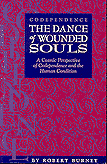
book ordering info

The Condition of Codependency
"The word changed and evolved further after the start of the modern Codependence movement in Arizona in the mid-eighties. Co-Dependents Anonymous had its first meeting in October of 1986, and books on Codependence as a disease in and of itself started appearing at about the same time. These Codependence books were the next generation evolved from the books on the Adult Child Syndrome of the early eighties.""The point that I am making is that our understanding of Codependence has evolved to realizing that this is not just about some dysfunctional families, our very role models, our prototypes, are dysfunctional. Our traditional cultural concepts of what a man is, of what a woman is, are twisted, distorted, almost comically bloated stereotypes of what masculine and feminine really are."
"We are set up to be emotionally dysfunctional by our role models, both parental and societal. We are taught to repress and distort our emotional process. We are trained to be emotionally dishonest when we are children."
(All quotes in this color are from Codependence: The Dance of Wounded Souls) So often when I am working with someone, helping them to understand their codependency, they will say, "Why didn't I learn this sooner. I feel so stupid that I have have wasted so many years in denial about how much my childhood experiences were running my life."
What I need to remind them of, is that the information we have now wasn't available when they were growing up. It was in only the late 70s and early 80s that researchers were able to identify the Adult Child Syndrome, that family dynamics researchers were starting to speak of the concept of dysfunctional families. Before Betty Ford had the courage to go public with her recovery from alcoholism in the late 70s, there was very little information widely available about alcoholism. Phil Donahue started bringing controversial topics out of the closet in the 70s, and was followed in the 80s by Oprah Winfrey. These were the first times that such subjects as child abuse and incest were openly discussed in American society. Denial, keeping secrets, had been the traditional norm in both families and society.
Children now are being taught in school and through the media, that it is good to have boundaries (just say no) and to talk about their feelings. There are books and classes now in healthy parenting. This is a major leap forward for society. It was not long ago, that the philosophy of child raising was based upon a "this is right and this is wrong - and you better do right or else."
Unfortunately it still is for many families. And even more unfortunately, most of the kids that are being given healthier messages are still not getting healthy role modeling. Role modeling is just as important - if not more important - in the developmental process for children than direct messages. "Do as I say, and not as I do," does not work when it comes to parenting.
The reality of human development is that we form the foundation dynamics of our relationships with self, with life, and with other people in early childhood. Our relationship patterns are pretty embedded by the time we are 4 or 5 years old.
Since there is no integration of the human developmental process into society - no real training of how to be healthy adults or real ceremonies / initiation rites to mark vital milestones / passages in development, such as puberty (junior high school as is it experienced in society is not a celebration of adolescence) - and no culturally approved grieving to take the emotional charge away from wounds caused by childhood trauma, we are stuck with those early childhood patterns.
We are trained in childhood to be emotionally and intellectually dishonest. Through both direct messages and watching our role models. We learned that it was very important to keep up appearances - to wear a mask. We watched out parents say nasty, judgmental things about a person when they weren't around and then be nice to them in person. We got told that it was not okay to speak our truth. There was an old song I always thought described how I saw people interacting, that went something to the effect "The games people play now, every night and every day now, never saying what they mean - never meaning what they say."
We were trained to be dishonest. We also got taught to be emotionally dishonest. We got told not to feel our feelings with messages like, don't cry, don't be afraid - at the same time we saw how our parents lived life out of fear. We got messages that it was not okay to be too happy when our exuberance was embarrassing to our parents. Many of us grew up in environments where it was not okay to be curious, or adventurous, or playful. It was not okay to be a child.
In any society where:
emotional dishonesty is not just the standard but the goal (keep up appearances, don't show vulnerability);results in a very emotionally unhealthy society.as children we learned that we had power over other people's feelings (you make me angry, you hurt my feelings, etc.);
being emotional is considered negative (falling apart, loosing it, coming unglued, etc.);
gender stereotypes set twisted, unhealthy models for acceptable emotional behavior (real men don't cry or get scared, it is not ladylike to get angry);
parents without healthy self esteem see their children as extensions of self that can be either assets or deficits in their own quest for self worth;
families are isolated from any true reality of community or tribal support;
shame, manipulation, verbal and emotional abuse are considered standard tools for behavior modification in a loving relationship;
long embedded societal attitudes support the belief that it is shameful to be human (make mistakes, not be perfect, to be selfish, etc.);
any human being is denigrated and held to be less worthy for any inherent characteristic (gender, race, looks, etc.);
We were set up to be codependent. We were trained and programmed in childhood to be dishonest with ourselves and others. We were taught false, dysfunctional concepts of success, romance, love, life. We could not have lived our lives differently because there was no one to teach us how to be healthy. We were doing the best we knew how with the tools, beliefs, and definitions we had - just as our parents were doing the best they knew how.
We have new tools now. We have information and knowledge that was not available until recently. We can change the way we live our lives. It is important to stop shaming ourselves for living life the way we were programmed to live, in order to start learning how to live in a way that is more functional - in a way that works to help us have some peace and happiness in our lives. The only way to be free of the past is to start seeing it more clearly - without shame and judgment - so that we can take advantage of this wonderful time of healing that has begun.
Codependency has been the human condition. We now have the knowledge and power to change our relationship with ourselves. That is how we can change the human condition.

The next article in the Codependence section is: What is codependency / codependence ?

